Showing posts with label classic. Show all posts

7 Sept 2013

Review: ANIMAL FARM by George Orwell

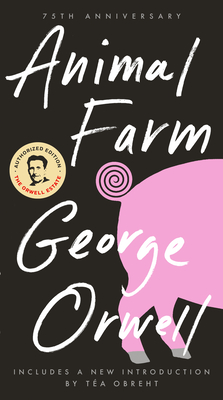
animal farm cover
It took me a ridiculously long time to figure out that pink shape was a pig.

The animals of Manor Farm are miserable. They're overworked, underfed, the farmer takes away their children, and they're killed when they're no longer "useful" to him. Then they get the chance to oust the farmer and establish their own farm, the Animal Farm, where all animals are equal! Only some animals fancy themselves more equal than others...

This is my first read by George Orwell, and it's terribly clever. It's short—just slightly over 100 pages—and the premise is simple. That's the genius of it: Animal Farm could be a parable about any uprising from the French Revolution, to the Bolshevik Revolution, to the Egyptian Revolution in 2011. Perhaps even the American Revolution. It was chilling yet totally convincing.

That's not to say the book is all political talk. It's also about society and economics and technology. But more than that, it's a great story that makes you think, and the animal characters are surprisingly sympathetic. Right from the beginning you feel for them, even though it's obvious their dream of a utopian society is NOT going to work. From the vain pony, Molly, to the cynical donkey Benjamin, the animals feel like characters you can identify with. I spent the entire book on the edge of my seat hoping the noble workhorse Boxer wouldn't die, even though I KNEW he would. And when it did happen, it was even more awful and cruelly ironic than I anticipated.

I was also surprised by the message of the novel. When I first started it, I figured the moral would be that the animals' idealistic society was doomed to fail because animals (read: people) were inherently selfish and out for themselves, but that wasn't the case at all. The majority of the animals were good, or at least good up to a certain point; they worked hard just on the basis of hope for a better life and that someday it would pay off. The reason Animal Farm failed was actually because it was modeled directly off of the human world and Manor Farm. The pigs got all their ideas from human books, even applying war maneuvers from Ancient Rome! Pretty soon some of the pigs were acting like Roman Emperors. It's the culture and system itself that supported exploitation and oppression, which is why it was nearly impossible to change.

Animal Farm entertained me while making me think about things in a different way. Just see if I don't start shouting, "Four feet good, two feet bad!" the next time I see a pundit on TV. I would recommend this novel as a must-read to everyone.


Discus this post with me on Twitter, FaceBook, Google+ or in the comments below.

20 Jul 2013

Review of THE LADY VANISHES by Ethel Lina White

cover of the lady vanishes book

(Actual title is The Wheel Spins, but Amazon and Goodreads have apparently decided to rename it. To be fair, The Lady Vanishes is a much better title.)

Iris Carr is a spoiled, wealthy young woman on holiday at some vaguely Alpine resort filled with English tourists. After catching the last train out to Trieste, Iris meets the bubbly Miss Froy, a middle-aged governess returning to England after years abroad. Iris decides to take a nap and when she wakes up, Miss Froy has disappeared. Even more strange is that everyone denies she was even on the train! Certain that something terrible has happened to Miss Froy, Iris enlists the help of the men folk, but they think she's crazy. After a while, Iris starts to wonder if they aren't right.

If you've seen the movie by Alfred Hitchcock, The Lady Vanishes, Ethel White's novel is very similar (in Fear in the Sunlight, Nicola Upson painted Hitch as someone who had no respect for the original work when adapting novels to film; she obviously knows shit-all about Hitchcock movies), right down to the time symbolism and British ethnocentrism. Honestly, the only difference between the book and the movie is that White gives us a ton of backstory about all the other English passengers on the train and why they don't mention they've seen Miss Froy, plus scenes of Miss Froy's family waiting for her in England. So we know from the outset that Miss Froy is real and not a figment of Iris's imagination, which kind of takes the fun out of the whole thing. I also really didn't care about the other English passengers. At all.

In other words, the movie is better than the book. Don't feel the need to read The Wheel Spins/Lady Vanishes, even if you love the movie.

That being said, I found the elaboration of themes in the novel interesting. You might be familiar with a story Hitchcock told François Truffaut in their 1962 interview about The Lady Vanishes and how it was based on a "true story" of a mother and daughter who traveled to Paris at the start of the Paris Exposition and checked into separate rooms in a hotel. When the daughter woke up from a nap, her mother was gone, her luggage had disappeared, and the room didn't appear to have been slept in. When the daughter asked the desk clerk, he said she'd checked into the hotel alone, and everyone else from the maid to the coachman who'd taken them to the hotel confirmed the desk clerk's story. People assumed the daughter was crazy. In fact, during the daughter's nap, her mother had died of the plague. The hotelier and city officials, fearing a plague scare would keep people away from the Exposition, decided to bury the body and pretend as if the woman had never existed.

That story is actually in the novel, along with several other urban legends that underscore how women are presumed to be neurotic and delusional until proven otherwise, and also how easily a woman's identity can be erased. I really liked that there are stories-within-stories in The Wheel Spins that served to create an atmosphere of paranoia on the train, although I don't think White cashed in on this as effectively as Hitchcock did.

Another thing I found interesting was the role of men in the story. There are only a few male characters, but the women are completely dependent upon them because only the men can communicate with the outside world (well, except for Miss Froy: she speaks 10 languages, although we never actually see her speaking any foreign language during the course of the book). The Professor and "Hare" (a reference to the white rabbit from Alice in Wonderland?), two Englishmen who help Iris, are both linguists and fluent in whatever language the locals speak; but even men who don't speak the language can communicate with the outside world. For example, the clergyman who stayed at the same hotel as Iris left every day to sit with the locals in the village, leaving his wife behind to remark that she didn't know how he communicated with them when he didn't speak one word of the language. A big deal is also made of the fact that Iris is absolutely terrible with languages, so that everything she says to local people on the train is interpreted through a male voice—and a misogynist male who thinks she's by turns annoying and delusional, at that. The Wheel Spins really underscores female dependency on men, much more so than The Lady Vanishes.

I actually did enjoy the first half of The Wheel Spins, but Iris started to get annoying because she constantly runs to either the Professor or Hare to fix things for her when that is CLEARLY not working. Why doesn't she do something herself? The second half is also filled with literally paragraphs upon paragraphs of exposition telling us about character motivation. TELLING, not showing. The conclusion of the novel was also a disappointment. I love the end of The Lady Vanishes movie because Miss Froy turns out to be a badass, and there are a ton of fun magic references and a shoot-out. That does NOT happen in The Wheel Spins. I won't spoil the ending for you, but it was really lame, drawn-out, and anti-climatic.

Basically, you could spend five hours of your life reading this book, or ninety minutes watching the movie. Not to mention the book isn't in the public domain (and yet the movie is... makes no sense), so you actually have to pay for it. Not worth it. I'd only recommend The Wheel Spins/Lady Vanishes to those with a vested interest in Pre-War women and literature.


Discus this post with me on Twitter, FaceBook, Google+ or in the comments below.
28 May 2013

Armchair BEA: Classics

armchair bea button
Design credit: Sarah of Puss Reboots

This year for Armchair BEA we're being asked to write about genre fiction for our daily topics, and today we're addressing the issue of classics.

I used to avoid classics, especially after high school, because I was forced to read a lot of classics I didn't like and I thought they were hoity-toity and boring (except for the few I LOVED, of course, like Jane Eyre, Pride and Prejudice, and The Great Gatsby). Nowadays, I read so many classics I started a my own classics blog, The Project Gutenburg Project! So what changed? Basically, thanks in large part to Project Gutenberg, Librivox, and Redeeming Qualities, I realized that there were all these entertaining, fun classic novels out there, waiting to be rediscovered.

If you have a favorite genre, chances are you can find that genre as a classic. I've been exploring classic mysteries from Edgar Allan Poe's Inspector Dupin stories (considered the first mysteries), to Sherlock Holmes and Agatha Christie, and it's been soooo much fun. Or romance! Ivanhoe, Vera, or an Emilie Loring novel will hit the spot. How about adventure? You can't go wrong with Rafael Sabatini, The Three Musketeers, or The Thirty-Nine Steps. Sci-fi fan? Try Robert E. Howard or Edgar Rice Burroughs.

Second of all, classics are curious. There are a lot of similarities to modern literature and some differences that are just bizarre. And I LOVE the bizarre books most of all. A few years ago I couldn't stop reading romances, and now I can't stop reading classics. It's like a sickness.

Anyway, if you want some recommendations for classics, just ask me in the comments and I'll try my best to think of something. Or check out the recommendation flow chart I made up (and need to update).

And if you have a favorite classic you think I'd like please let me know!


Discus this post with me on Twitter, FaceBook, Google+ or in the comments below.

5 May 2013

Great Gatsby Readalong Chapters 5-6


How excited are you for The Great Gatsby movie on a scale of one to a bazillion? I swear Gatsby takes up 80% of my brain power right now. Anyway, as I mentioned last week, my friend Becky from One Literature Nut is hosting a readalong for The Great Gatsby in preparation for the upcoming film. This week, we're discussing chapters 5 and 6, wherein Daisy and Gatsby "reconnect." If the cottage is a-rockin' don't come a knockin'!

Questions:

I'm reminded of a psychology lesson I once learned, that states that the person with the least interest in the relationship, controls it. Is that person Daisy? Is she so "secure" with Tom that Gatsby could be no more than a momentary diversion from her unhappiness? The person with the least interest in a relationship controls it? Was this psychology teacher a frat boy, perchance? One of the authors of The Rules? I think that's called playing hard to get. BUT ANYWAY—I definitely don't think Daisy's as hung up on Gatsby as he is on her. He's set her up to be the be all and end all of his happiness, which is a lot for a person to live up to. But I'm not sure she controls the relationship or even recognizes the power she has over Gatsby.

Did you have any lines that jumped out at you in these chapters? The line that made me laugh was this one:
Gatsby, pale as death, with his hands plunged like weights in his coat pockets, was standing in a puddle of water glaring tragically into my eyes.
With his hands still in his coat pockets he stalked by me into the hall, turned sharply as if he were on a wire, and disappeared into the living-room. It wasn’t a bit funny.
Sorry, Nick, but that sounds hilarious. Gatsby is so funny.
Another line that stood out to me was when Nick tells Gatsby, "I wouldn't ask too much of her, you can't repeat the past." Someone's talking but Gatsby ain't listening to youuuuuuuu.

How has your opinion of Gatsby and Daisy changed now that they have finally met again? Hm, I don't know. On one hand, Gatsby is so vulnerable in certain scenes, like the one I quoted from above, that it's hard not to feel for the guy. But on the other hand I don't think Daisy necessarily brings out the best in him; he seems obsessed with appearances and material possessions after they hook up. As for Daisy, who knows? I don't know what to think about a woman who cries over shirts. These two might be better on their own than together.


Discus this post with me on Twitter, FaceBook, Google+ or in the comments below.

29 Apr 2013

Great Gatsby Readalong Chapters 1-4

gatsby readalong button

Becky from One Literature Nut is hosting a readalong of The Great Gatsby before the movie starts. You can still join in if you like! I got kind of a late start because I was waiting for the audiobook from the library, but I finished the book this weekend and am ready to catch up.

Discussion Questions from Becky:


  • What role(s) do you see for the setting in the novel? Do you like this setting, and does it affect the way you read the story? I don't live on the East Coast so I have no opinion about the Hamptons--I mean, East and West Egg. The Eggs?--but I did notice that the Egg Gatsby lives on is the less fashionable one. He can't do anything right.
  • Since Nick is the narrator in this story, do you think it's possible he might be setting us up to like or dislike certain characters? Do you trust his retelling? I don't think Nick likes anyone in this book, including himself. I'm not sure he knows what "liking people" means. He just does things because it's expected, not because he likes or dislikes it.
  • What do you think of Tom, Daisy, and Myrtle? Tom's obviously an ass hole. Daisy thinks she's clever but only because she's around Tom too much, and Myrtle's just desperate.
  • What else stood out to you in these opening chapters? I kind of hate Nick. Everyone in this book is so conventional, they need someone to save them from themselves. And speaking of our savior...
  • What do you think of Gatsby's absence from his own parties? I think it's a metaphor for his life. The parties and the whole Great Gatsby persona are kind of hollow because they don't have anything to do with him, they're just a trap lure Daisy. He's not present in his own life just like he's not present at his parties.
  • Is Gatsby a character you feel sympathy or cynicism towards? I definitely sympathize with Gatsby--he's the only character in the entire book who has ANY imagination--but dang dude, take a pill and chillax. He's actually an awesome person, but he's trying so hard to be someone else and he's so awkward and desperate.
  • Are we supposed to feel for Daisy as Jordan does, and if she really wanted to meet up with Gatsby again, wouldn't she already have done it? I honestly don't feel anything for Daisy. She's hardly even a character, just a symbol. Eighty percent of what she does makes no sense.
  • Is there anything else that stood out to you or you questioned? I loved the scene in the library where the guy was like, "Real books, with pages and everything!" The moment when Gatsby and Nick first met also kind of made me hate Nick, because it seems like they could be friends and then Nick gets all Judgey McJudge and is like, "What a poseur." You're a poseur Nick! I don't see you being awesome.


Stay tuned next week when we discuss chapters 5-6, which hopefully I won't have completely forgotten by then.

Discus this post with me on Twitter, FaceBook, Google+ or in the comments below.