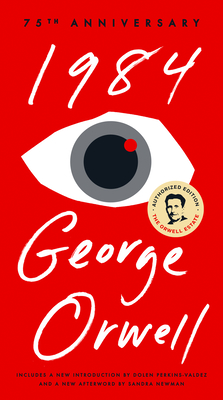
Winston Smith is a lonely man living in the London of our dystopian future, with Big Brother watching every move people make and the Thought Police ready to take any dissenters down. Winston hates Big Brother and has a vague desire to join "the Brotherhood," a group lead by Emmanuel Goldstein, the Enemy of the State. But it isn't until Winston falls in the love that the Thought Police really come after him...
If Animal Farm is George Orwell's vision of communism, Nineteen Eighty-Four is his vision of totalitarianism. And just for the record, I'm already really annoyed at writing out "ninety eighty-four," so from now on it's just 1984. Okay? Okay.
I didn't enjoy 1984 as much as Animal Farm. Or, you know, at all really. There is sooooo much exposition about this and that and how everything works that it tried my patience. Winston is a misogynistic wet blanket and I had trouble caring about what happened to him, even when it was horrifying.
That's not say I think 1984 is a bad book, just that it's more about the world of the novel and ideas than story and characters. And some of the ideas are really brilliant! Things like Big Brother and the Thought Police are already part of the lexicon, but what I found fascinating was the concept of doublethink:
To know and not to know, to be conscious of complete truthfulness while telling carefully constructed lies, to hold simultaneously two opinions which cancelled out, knowing them to be contradictory and believing in both of them, to use logic against logic, to repudiate morality while laying claim to it, to believe that democracy was impossible and that the Party was the guardian of democracy, to forget whatever it was necessary to forget, then to draw it back into memory again at the moment when it was needed, and then promptly to forget it again: and above all, to apply the same process to the process itself. That was the ultimate subtlety: consciously to induce unconsciousness, and then, once again, to become unconscious of the act of hypnosis you had just performed. Even to understand the word ’doublethink’ involved the use of doublethink.
This, combined with newspeak, the language of Big Brother, allows people to say anything and mean nothing. There's no longer an opposite of good, because why use the word "bad" when you can just say "ungood"? The ultimate goal of newspeak is to eliminate most words altogether. After all, as long as the word freedom exists, people will remember there was such a thing.
Memory, both historical and personal, serves a major role in 1984. Government altering history and the short-term memory of its citizens was touched upon in Animal Farm, but in 1984 that loss of memory is a cornerstone of the narrative. Winston doesn't know for sure it's 1984, can barely remember his mother and sister or any incident from his childhood, and is eventually completely brainwashed into forgetting he ever hated Big Brother. The only reality is the one created by the state. Everyone is sharing in a delusion, their view of the world slightly twisted until they're all participating in massive "group think." Anyone who doesn't conform to the universal opinion isn't just wrong, but considered insane, even though they're only sane people in the bunch. This isn't just a case of looking at the world through rose-colored glasses, but of "two and two make five": it's not logic, it's not reality, but it's the truth because Big Brother says it is. It reminded me of the empty Obama chair from the GOP 2012 convention.
Anyway, an interesting book. I'm not sure I would universally recommend it like I would Animal Farm, but if you're into dystopian fiction, 1984's the mother of all dystopian novels. It's also the only one that's ever really sent a chill up my spine because not only could it happen, it nearly did.
Discus this post with me on Twitter, FaceBook, Google+ or in the comments below.